Authors Note: A client of mine told me about this back in 2014 and I have not stopped talking about it since then. Nothing has influenced my thinking on technology strategy more than this framework, and I am excited to share it with you.
Young brilliant minds can be unencumbered by they way things are and, when effectively unleashed, can come up with solutions that are revolutionary in their simplicity and scalability.
“It doesn’t make sense to hire smart people and tell them what to do; we hire smart people so they can tell us what to do.” – Steve Jobs
“I hire people brighter than me and get out of their way.” – Lee Iacocca
This is great when re-thinking how people communicate, shop, or travel. It’s not great when these brilliant minds are trying to re-invent your accounting software.
Critical to your success is understanding when innovation is truly needed, and when the default is good enough. Unfortunately most organizations are not able to strike a balance. They either try to re-invent EVERYTHING or copy EVERYTHING. Below is a framework that you can use to have it both ways.
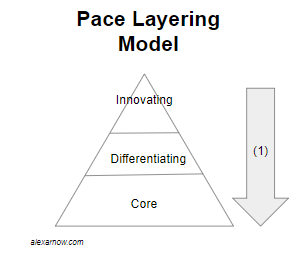
The pace laying model divides your application infrastructure up into 3 main components – each with a different purpose and a different strategy to it. The arrow (1) demonstrates the direction of technology (towards commodification) so you always want to make sure that what you are innovating can fit into your platform and your core infrastructure to support scalability. This is why an MVP should be well engineered, not an excuse for sloppy work. If it is effective, it will be a big part of your infrastructure for years to come. From the bottom up, the different layers are as follows:
- Core Systems – Commodity applications (like accounting software or CRM) that are commercial available and are relatively mature (i.e. they have been around a long time and have not changed much) as a technology. These systems need to to work 100% of the time and changing them should be rigorously justified. Flexibility isn’t important for core systems, consistency is.
- Differentiating Systems – These consist of the “secret sauce” that differentiates your business in the marketplace. It could be great customer service, a strong social media capability or a friction less buying experience. These applications are in their teens – they need to be able to scale and work reliably, but they also need to be flexible enough to respond to the needs of customers and the marketplace.
- Innovating Systems – Are the next big bets of the organization. These applications are more likely to fail than be the next big thing (and that’s the point!). They need to be flexible, nimble, and able to use data to demonstrate their utility and prove their initial hypothesis. If it doesn’t work? Shut it down and move on.
The value of this framework is it enables decision makers (like you today, or you someday!) to best prioritize your efforts and determine what the best solution is. Innovative? go for it! Core? Probably best to see what else is out there. Tactically you can use this framework like this.
- Don’t re-invent the wheel – Core applications are mature, and you are probably better off partnering with someone who has been doing it a long time. You don’t need to re-invent accounting software, just find someone who has been doing it well and copy them. This allows you to focus your resources where they needed and ensures that you can take advantage of established learning and best practices.
- The messy middle – When you find something that makes you stand out, make sure that it can be easily integrated into our core infrastructure. This is how you can create a platform (I know, everything is called platform these days, but before it got jargony this is what it meant). Ultimately, these applications will be copied and commodified and it is important to build the right infrastructure with that in mind so that application maintenance and overhead can decrease over time rather than increasing in the form of a large scale re-platforming.
- Re-invent the wheel – Focus your resources and creativity on understanding your customers and solving the next problem they didn’t even know they had. This is where innovation plays a key role and will ensure that you are successful in the future.
But what does this have to do with data?
Organizations get in trouble because they assume that they can use the same approach with all of the different software applications they have. In this case, the wrong framework means that the right outcomes won’t be achieved. If you are re-inventing commodity software in the name of innovation, you are wasting resources and losing time while other, more innovative companies, are able to build more effectively. If you outsource everything, you are essentially settling for “good enough” which is not innovative enough for today’s “winner take most” market place.
Since every system is biased towards how it is measured, and data won’t tell you what to do it will only confirm “what is”, how you measure success using this framework is important. Using historical data and trying to extrapolate only works in the “core” part of the framework because the technology is mature, well established and we can assume that past performance predicts future results. If you want to do something new, you need an idea and you need to run a test. This is how innovation works, you have an idea (not data driven) and you implement it and test it to confirm that it is a good idea (data driven).
So the further you go up on the pace layering model, the more likely you need a test for your idea and the further you go down, the more you can rely on historical data.
 Please Think Responsibly